


HARMONIZE EXT-SC82: Designing Beyond Conventional Manufacturing
A parametric rider-support system developed for the Honda CBR1000RR-R through additive manufacturing.
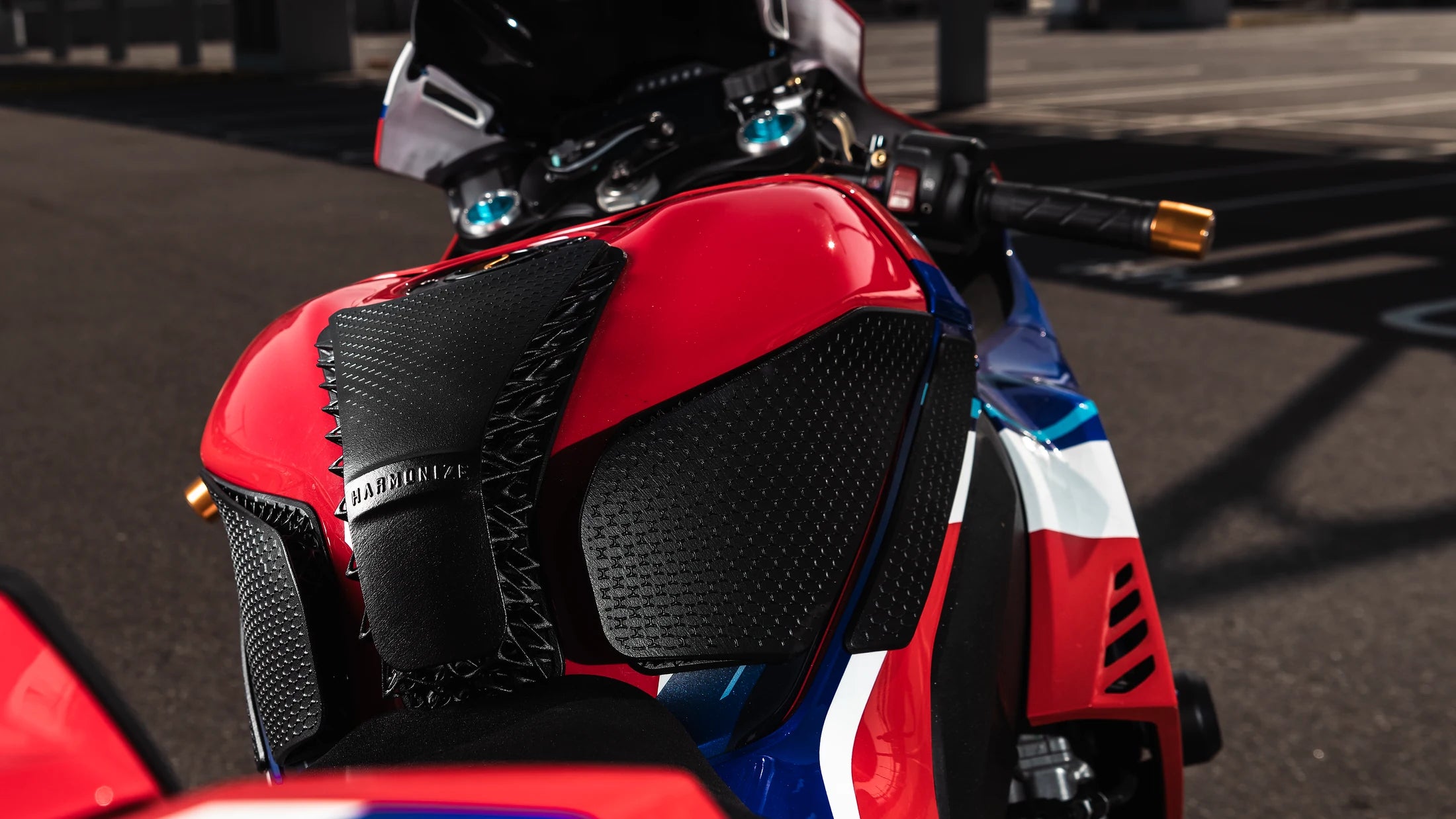
Some products begin with a market need.
The HARMONIZE EXT-SC82 began with a challenge.
At the start of the project, we asked one simple question:
What could we create if manufacturing no longer defined the limits of the design?
Additive manufacturing offers more than a different way to produce a component. It allows geometry to be developed without first simplifying it around the constraints of conventional tooling, machining paths, or mold construction.
Structures can intersect, transition, extend, and build relationships across multiple dimensions in ways that would be difficult to realize efficiently through conventional production methods.
We wanted to make that freedom visible.
More importantly, we wanted to understand whether that freedom could become part of the function of the product itself.
That question became the foundation of the HARMONIZE Multi-EXT.

Beyond Conventional Manufacturing
From the beginning, the objective was not simply to create another version of an existing motorcycle component.
We wanted to explore a different type of rider-support product—one whose form would not begin with the assumptions of a conventional tank cover, molded shell, or machined structure.
Instead of asking how an existing product could be redesigned, we began by asking what additive manufacturing itself could make possible.
That question led us toward one of the most familiar elements of the additive manufacturing process: the support structure.
In conventional 3D printing, supports are temporary.
They exist to make production possible, holding geometry in place during the printing process. Once manufacturing is complete, they are removed and discarded.
But that temporary structure introduced a different possibility:
What if the support structure was no longer something to remove? What if it became part of the product itself?
The idea was especially relevant to the EXT-SC82 because the product was already being developed as a physical interface between the motorcycle and the rider.
A structure originally intended to support the manufacturing process could become the inspiration for a structure designed to support the rider.
That connection established the conceptual starting point of the project.
Design Criteria
Manufacturing freedom did not mean designing without constraints.
The structure still had to belong to the Honda CBR1000RR-R.
Its proportions, direction, density, and overall volume needed to integrate with the motorcycle rather than appear as an isolated geometric object.
At the same time, the EXT-SC82 had to function as a rider interface.
Contact position, surface transitions, and the way the structure occupied space around the motorcycle therefore mattered just as much as its visual character.
And because the final geometry had to exist as a physical product, the design also needed to remain connected to the realities of additive manufacturing.
These considerations established the framework for the project:
motorcycle, rider, geometry, and manufacturing could not be treated as separate problems.
They had to be resolved as one system.

From Generated Support to Designed Structure
Our earliest experiments took the most direct approach.
We allowed slicing software to automatically generate the support geometry.
From a manufacturing perspective, it worked.
From a design perspective, it did not.
The automatically generated structure was functional, but visually arbitrary. Its density, direction, intersections, and rhythm existed because the software required them—not because they expressed a deliberate design decision.
For a project intended to explore the design freedom of additive manufacturing, that distinction mattered.
Simply exposing an automatically generated support structure would demonstrate a manufacturing process.
It would not demonstrate a HARMONIZE design.
So we abandoned the easier solution.
Instead of allowing the slicing software to determine the final structure, we began rebuilding the geometry through parametric design.
What started as a manufacturing by-product now had to be transformed into an intentionally designed system.
This became one of the most demanding stages of the EXT-SC82 development process.
Parametric Development
The structure could no longer be treated as a random collection of supports.
Every local decision affected the way the larger form was perceived.
Density had to be controlled.
Transitions had to be intentional.
Connections between individual elements had to create continuity rather than visual noise.
And the resulting network had to integrate with the proportions and existing design language of the Honda CBR1000RR-R.
The final geometric system was constructed through more than 1,700 points and nearly 4,000 interconnected line segments.
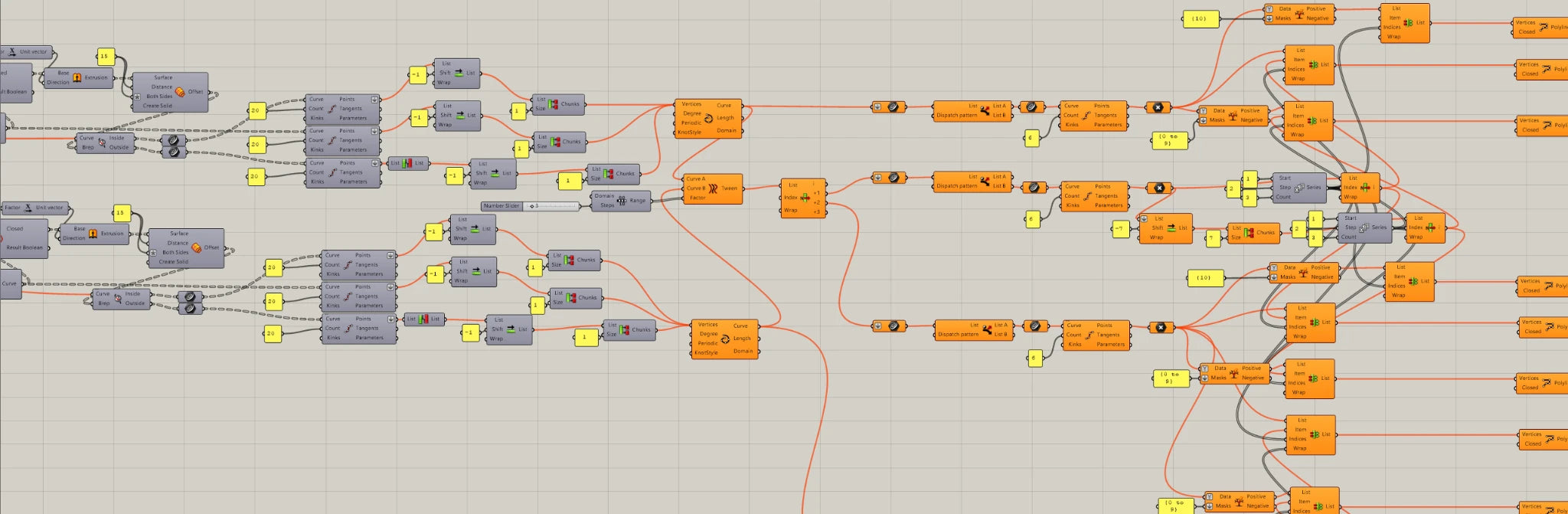
Those numbers were never the objective.
They were the consequence of developing the structure with enough resolution to control how the geometry behaved across the entire component.
Rather than repeating a single pattern uniformly, the network changes continuously.
Tightly grouped elements gradually transition into more open geometric relationships.
Intersections accumulate, separate, and redirect.
Individual elements define local structure, while their combined direction shapes the larger silhouette.
This relationship between density, transition, connection, and overall form became the underlying logic of the EXT-SC82.
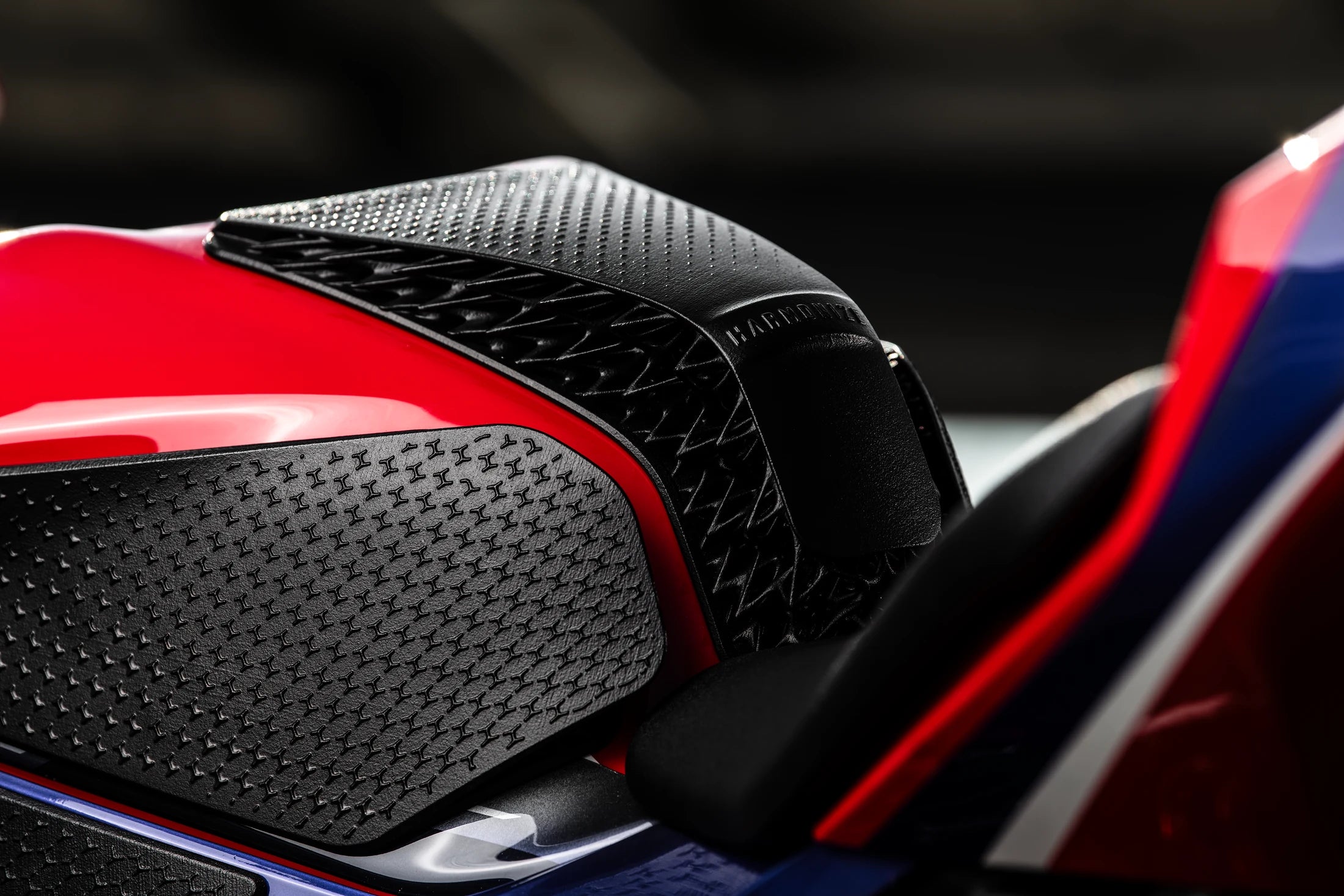
From the side, the structure develops a defined three-dimensional profile that extends rearward with the motorcycle.
Viewed from a distance, the component reads as one continuous form.
Viewed more closely, its individual layers, intersections, and variations in density begin to emerge.
The complexity is not intended to exist as decoration.
It is organized so that many individual geometric relationships resolve into a single visual system.
That balance between overall form and local complexity became one of the defining characteristics of the EXT-SC82.

A New Meaning of Support
At this stage, the structure was no longer present because manufacturing required it.
It was there because we had chosen to make it part of the product.
That distinction defines the EXT-SC82.
The project takes an element normally hidden inside the manufacturing process and brings it forward as the visible language of the finished component.
But the idea extends beyond appearance.
Throughout the project, the meaning of support changes:
The manufacturing concept, visual language, and function of the finished product are brought into the same design system.
This was the point at which Multi-EXT became more than an experiment in additive manufacturing.
It became a rider-interface project.
From Geometry to Contact
For HARMONIZE, visual experimentation alone was never enough.
No matter how sophisticated the digital geometry became, the EXT-SC82 still had to function as a physical interface between the motorcycle and the rider.
The system was developed around two primary riding situations.
During braking, the raised structure provides an additional surface that the rider can use for lower-body bracing.
During cornering and body-position transitions, it provides additional contact areas that can be used as the rider moves around the motorcycle.
This changed the way the geometry had to be evaluated.
A form that appears compelling on a computer screen can feel completely different once it comes into contact with the human body.
Angles, transitions, surface position, and overall volume could therefore not be judged only as visual geometry.
They had to be considered through contact.
The question was no longer simply:
Does the structure look resolved?
It also had to answer:
Does the structure feel resolved when the rider actually interacts with it?
The objective was not to make the product feel complex.
It was to make a complex structure feel natural when it was actually used.
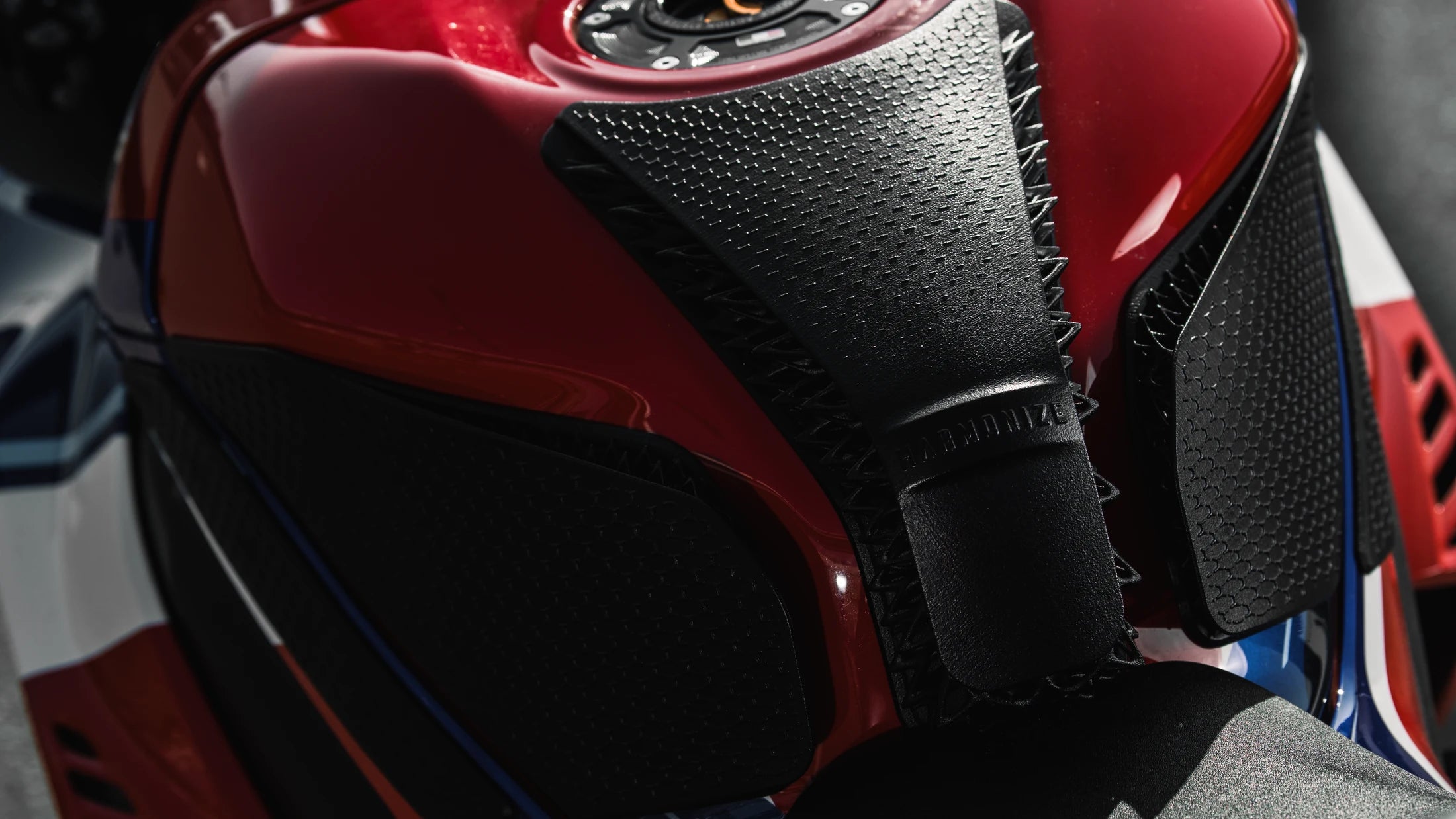
“It looks this complex, but it feels surprisingly natural when you actually grip it.”
The interaction should not.
For us, that response captured something important about the project.
The visual complexity was immediately apparent.
The complexity of the design process was not.
Once the rider made contact with the product, the geometry no longer needed to explain how it had been constructed.
It simply needed to work as an interface.
That distinction became one of the most important outcomes of the EXT-SC82 development.
The Beginning of Multi-EXT
The EXT-SC82 eventually became more than a single product.
It established the starting point for a new HARMONIZE product line.
However, later Multi-EXT products did not simply reproduce the EXT-SC82 geometry.
That was intentional.
The EXT-SC82 was a deliberately ambitious design experiment. Its structural complexity demonstrated what could happen when additive manufacturing was allowed to influence the design from the very beginning.
But a product line cannot be built around the repetition of one form.
Different motorcycles have different proportions.
Different riders interact with motorcycles differently.
Contact positions, riding posture, available installation areas, and production requirements change from one application to another.
As Multi-EXT developed, the geometry evolved with those conditions.
The original visual form was not treated as a fixed formula.
Instead, later development increasingly focused on the relationship between:
rider, motorcycle, contact position, geometry, and manufacturability.
This allowed Multi-EXT to adapt to different applications without requiring every product to reproduce the same structural complexity as the EXT-SC82.
The geometry changed.
The principle remained.
The result was not a repetition of EXT-SC82.
It was a continuation of what EXT-SC82 had established.

From Manufacturing Support to Rider Support
The EXT-SC82 began as an exploration of what additive manufacturing could make possible when conventional production constraints were no longer allowed to define the form from the outset.
Parametric design gave us the means to control that freedom.
Physical interaction gave the geometry its purpose.
The result was not simply a more complex component, but a different way of thinking about the relationship between manufacturing, structure, and rider contact.
What began as a temporary element of the manufacturing process ultimately became the central idea behind the finished product.
A structure that originally existed only to support a manufacturing process became the inspiration for a product designed to support the rider.
That was where Multi-EXT began.
EXT-SC82
Parametric rider-support system developed from the manufacturing and interface principles established in this project.